

MATTIA BREUZA
Entrepreneur | Breuza Ingegneria Naturalistica
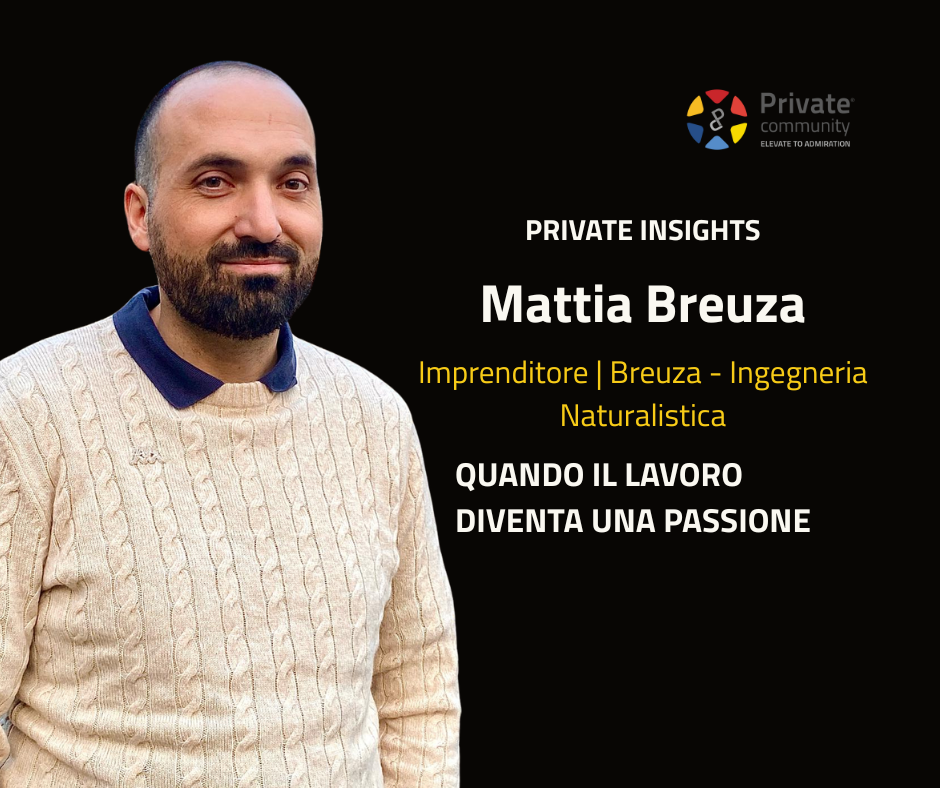
The story of MATTIA BREUZA - Entrepreneur | Breuza Ingegneria Naturalistica
When I was first asked to join Private Community, I was genuinely sceptical. I come from a world where "real" work happens on site: natural engineering, earthmoving, machinery, soil, open building sites. Everything that isn't physical, tangible, measurable at a glance - things like courses, meetings, training - has always felt, to many people and to me first of all, like time taken away from the business.
For a few years I turned the idea down. I kept thinking my job was to be on site, checking the work, handling operations and nothing else. Then came an invitation from someone I trust a great deal. He kept insisting, with that simple directness that eventually backs you into a corner: "Come at least once. Worst case, you'll have got a free dinner out of it."
I told myself that, after all, I didn't have much to lose. So, more out of trust in the person than in the idea itself, I said yes.
That first evening was nothing like I'd imagined. I found myself among a very mixed group of entrepreneurs and professionals, different in sector and company size, but with a closeness and openness I hadn't expected. It wasn't the usual cold, theoretical training. It was a place where people genuinely talked about what was happening in their businesses, with no filters.
What struck me most at the start was a discovery that seemed obvious but was, for me, eye-opening: businesses completely different from mine - some in farming, some in other sectors - had problems very similar to my own. One evening, sitting next to a farming entrepreneur, we spent half an hour talking about the same difficulties with foreign labour that I deal with on my sites. I thought: if he, doing work so different from mine, finds himself in the same situation, then I'm probably not a one-off. Maybe my business isn't as "strange" as I'd always believed.
That's where a deep shift in perspective began.
I work in natural engineering and earthmoving, a field where you're historically trained to think in very concrete numbers: I spend ten, I need to bring in fifteen to be left with five. For me, profit used to be the central goal, the thing I'd write down on the form when setting my targets: earnings, margins, turnover.
The Mindset and Skillset paths, though, led me to completely rethink that approach. I began asking myself who my ideal client really was, which projects were aligned with my values and which weren't. I discovered something revolutionary for me: not every client is a good client. I'm not obliged to work with someone just because they "pay". I can choose. I can decide to walk away from clients who, even while bringing in turnover, bring stress, conflict, and situations that don't reflect the way I want to work.
At the same time, I stopped treating money as the main goal. I began seeing it instead as the natural consequence of work done well. The real goal is to do good work, with care, professionalism and respect for my values. When that's clear and consistent, the profit follows. It's no longer the purpose, but the outcome.
Meanwhile, another important front opened up: my relationship with my staff. I used to have a very closed, almost defensive approach: I do my job, you do yours, and we talk only when strictly necessary. The important thing was that the work got done. Full stop.
With the path in Private, I began to change my tone. I started sharing more about where I wanted to take the business, what my values were, what I mean by "work done well". Above all, I began doing something that never used to come naturally to me: asking for their opinion. Asking how they see a problem, how they'd handle a particular situation.
It was eye-opening. I realised that the people working on the ground every day often have practical ideas, creative solutions, small tweaks that really make a difference. If I get to three on my own, they often bring me to four. For years, not asking was a waste - for me and for them. Now, when a suggestion comes in, I no longer look at "who" made it, but at how good the idea is. Over time, that's genuinely made us more like a team.
Another important step was finding the courage to say out loud something that, in the culture I come from, is almost scandalous: my work isn't just a job. It's also a passion.
For a long time I didn't dare say it. We live in a society where admitting you enjoy working isn't exactly popular. You're almost afraid of being judged for it. And yet, through talking with other Community members, I realised that passion wasn't just legitimate - it needed to be recognised and nurtured.
Today I can say quite comfortably that I don't do this job just for the pay cheque. I enjoy tackling complex challenges, finding technical solutions, improving the way the business is organised, and growing how we work. That doesn't mean the financial side isn't important, just that it's not the only measure I use for what I do.
The work I've done in Private hasn't stopped at the business. It has affected my personal life too. Talking with more established entrepreneurs, some admitted they'd realised too late that they'd sacrificed too much family time for work. Others, closer to me in age, told me how important it is to make clear decisions about your own time, without hiding behind the excuse of "I can't miss it".
I started thinking about priorities differently. Saying family matters isn't enough: you have to show it in your diary, in real choices. If there's an important moment for one of my children, I have to decide whether, right then, the site comes first or being there does. And I need the consistency to say so, even to clients and staff, without feeling any embarrassment about it.
Looking back, these two years in Private Community have been anything but a bracket of "theory" disconnected from reality. They've been deep work on myself: on how I see myself as an entrepreneur, on how I relate to people, on how I define the meaning of my work.
Today I experience my Natural Engineering business less as a weight on my shoulders and more as a challenge to be faced with awareness. And to think it all started with an invitation I initially wanted to turn down, and a dinner I went to almost by chance.