

Elisabetta Ramonda
Psychologist | Clinical Practice & Careers Guidance
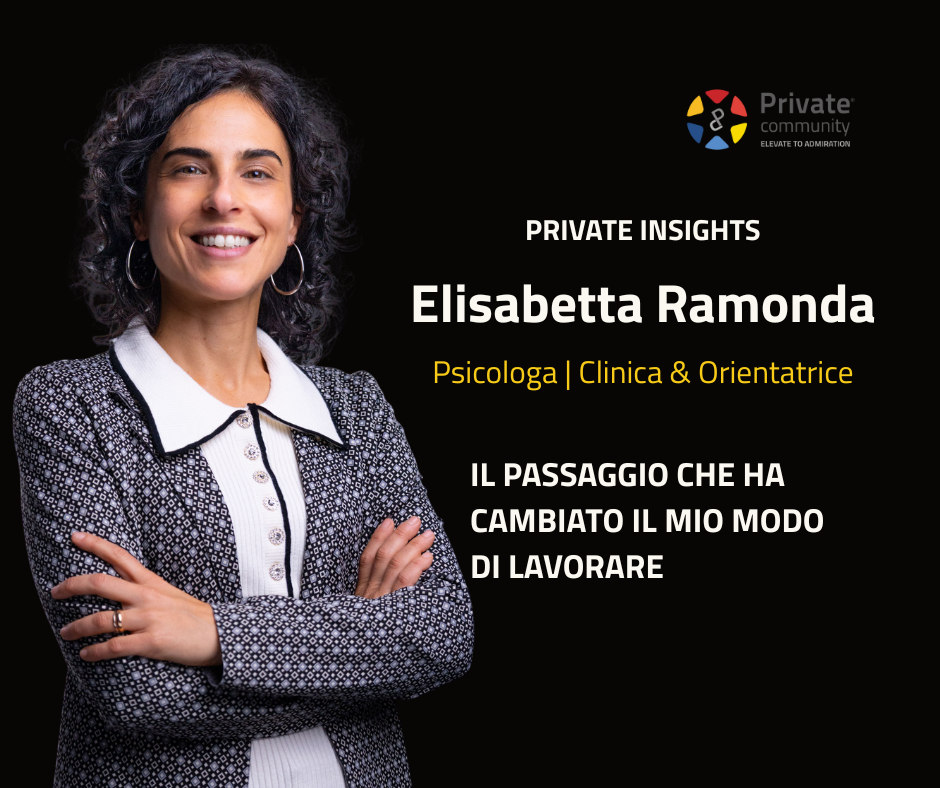
Elisabetta Ramonda's story - Psychologist | Clinical Practice & Careers Guidance
I came across Private Community at a crucial moment in my professional life. I'm a psychologist, and at the time I'd just decided to leave a stable, employed position to go into private practice. It wasn't a leap into the unknown: inside me there was a clear mission, felt for a long time, that needed room to grow. I wanted to give voice to a new approach to educational and career guidance, a subject I've known for years and always saw as full of potential – not only for people who need to choose "what to do", but for those who want to learn to know themselves, value themselves and build a direction before a crisis hits.
I had the training, the experience, the skills. And yet I could feel something was missing. It wasn't work I lacked: people, requests and urgent cases kept coming in. The point was that they often weren't the people I truly wanted to work with. As a clinician, I was used to welcoming the problem, the difficulty, the struggle. But I wanted to shift the centre of gravity: I wanted to speak to people who want to feel well too, who want to work on their own resources, who sense they can choose, grow and prevent rather than chase. And that's where a subtle, exhausting split opened up: I believed in what I wanted to bring, but I couldn't make it concrete in my day-to-day work.
Inside that frustration was a question I could no longer avoid: do the people I'm looking for really exist, or am I just telling myself a story? And above all, how do I reach them? It was in that "how" that I understood the truth: it wasn't a lack of courage. It was a lack of method.
Private arrived as a completion. Not as one more theory, not as a fleeting moment of inspiration, but as a structure capable of coming down to earth. I need concreteness, I need to experience first-hand what actually works. In Private I found a fast, tangible model that let me fill in missing parts and strengthen the ones already there. It helped me step out of the urgency of the "here and now" – not because the present doesn't matter, but because when you stay glued to day-to-day management you end up leaving no room for vision. I had a vision, but I didn't have a system to support it.
With concrete tools I mapped out my target more clearly, the professional opportunities I wanted, the partners aligned with my values. I simplified processes, focused my goals, and brought the outside rhythm in line with what I felt pulsing inside. And, above all, I learnt to make space. One of my strongest limiting beliefs was the idea that "having less" was a risk. I kept saying yes to requests that no longer fitted inside my container, and that automatic yes ate up time and energy that I could have put into what I wanted to build. Discussing it with others helped me see that dynamic with clarity, and gave me practical courage: not emotional courage, but the courage to choose. I started selecting, saying no, gradually cutting back what frustrated me, to truly make space for what I wanted.
In this, peer discussion was the most powerful lever. Because discussion, when it's protected and free of judgement, doesn't push you to change direction: it lets you see other angles while also strengthening your own. It's a double movement. It broadens your view and makes you more solid. On your own, you often stay within the same frame: thinking the same thoughts, asking the same questions, circling the same perimeter. Discussing things with others shifts you, sets you in motion, makes you discover possibilities you hadn't considered and, paradoxically, helps you recognise more strongly what's truly yours.
This is also where I understood the value of interconnected visions. Different people, with different roles and contexts, but united by a deep alignment of values and intentions. When you meet someone who speaks your language – your most authentic one – it doesn't just create understanding: it creates trust, sincerity, momentum. From there come strategic connections that turn into partnerships, collaborations, natural integrations. And that sense of belonging changes the quality of your work: you work better and you feel better. You feel part of the working group you'd always wanted, even when it isn't physically beside you.
In a professional world that often breeds loneliness and competition, I found a context of calm in Private. Here there's nothing to prove: you bring what you have, and you build. That feeling – so simple and so rare – recentred me. It gave me back a calmer, more productive way of working, and also a clearer idea of what I want to offer: value that's recognisable, effective, reliable, ever-evolving.
I joined Private with a dream. I believed in it, but I saw it as far off. Today, about a year and a half later, I see it as concrete, tangible, real. That's also why I chose to make myself available as Community Manager: because when you experience a model that truly works, you feel the desire to become an active witness to it. Not to convince, but to show the opportunity. Because sometimes you don't need to change direction. You need a method that makes it possible.