

Andrea Stalletti
Entrepreneur | Studio Tetti Stalletti S.R.L.
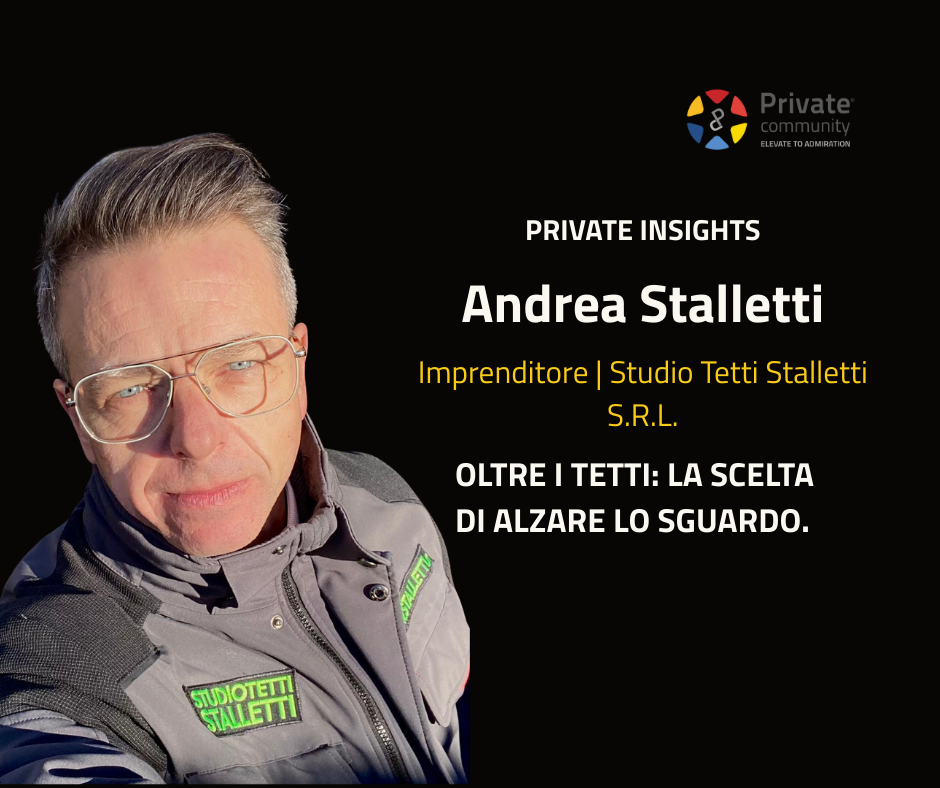
The story of Andrea Stalletti - Entrepreneur | Studio Tetti Stalletti S.R.L.
I grew up breathing in the scent of wood. My family has worked in this world for five generations: a historic sawmill that has lived through different eras, changes of leadership and shifts in the industry. In the 1970s, my father decided to expand the business by starting to build roofs, and that's how Fratelli Stalletti S.A.S. was born, founded together with my uncle.
When numerically controlled machinery arrived, in the early 2000s, we understood it was time to take a further leap. We transformed the company structure and founded Studio Tetti Stalletti S.R.L., with my brother and I joining. It was a natural but significant step: uniting tradition with the need to modernise processes, structure and vision.
Over time, though, I realised that the word ‘roofs’ no longer truly represented what we did. The term evokes a craft image, often poorly defined, far removed from the evolution our company had undergone. Today we build roof coverings, wooden structures and buildings, carports, pergolas, berceaux and complete constructions. We remain wood specialists, but in a much broader and more contemporary way than where we started.
Despite this, for years I remained trapped in the day-to-day. Building sites, urgent matters, weather, clients, the unexpected: every day seemed to be decided by events, not by me. I kept putting off important decisions, even though I knew I'd have to face them sooner or later. I already had the idea inside me that it was time for the company to be structured differently, but I didn't know where to start. Or, more honestly, I couldn't find the mental space to do it.
Joining Private Community marked the first real break in that cycle. The CED™ (Core Emotional Desire), the work on Vision and Mission, was a turning point for me. Not because it contained new information, but because it made visible what had always been there, buried under routine. Putting in black and white why I do this work and where I want to take the company had the effect of bringing order to everything: the family history, the skills I'd developed, my desires, my responsibilities, the future.
An important step in my journey was realising that simply ‘keeping the company going’ was no longer enough. I felt the need to give it a clear direction, especially thinking about the next fifteen years and the issue of generational transition. I have two teenage daughters who are starting to ask themselves questions about their future, and I myself could no longer afford to ignore questions like: what kind of company do I want to leave behind? In what form? On what foundations?
With Combine® I started working concretely on everything I'd been putting off for years. One example is the management software: I knew we needed a proper ERP, suited to the complexity of working-at-height contracts and collaborations with other companies. But for a long time I had circled around the issue without really tackling it. The focus sessions helped me define the essential requirements, prioritise, make decisions, and carry the work forward consistently.
Another area I unblocked was staff recruitment. Today the most critical resource isn't the client, but skilled labour. With Combine, I got practical tools: forms, evaluation criteria, tips for conducting interviews. I saw 25 candidates in one day, presenting the company with a clarity I'd never had before. It was a moment when I saw first-hand what it means to have structured support.
Then there's the more human side. During the CED™ (Core Emotional Desire), I found myself hugging someone I'd only met that same morning, sharing deep emotions. At fifty, that's not something you take for granted: it reminds you that an entrepreneur isn't just the role they hold, but the human being behind it. It's a memory I carry with me, a kind of compass in the most complex moments.
Looking back, I realise that for years I told myself I ‘didn't have time’. It was my recurring justification. And even today, now and then, I risk using it as an excuse. The truth is that when something really matters to me, I find the time.
My routine is demanding: I live in Milan, the company is in Valcuvia, 90 kilometres there and 90 back. I have two daughters, a wife who works all day, a company that operates in people's homes, with real emergencies. And yet I get up at five, I'm at the company by seven, and during my lunch break I carve out an hour and a half to train. Not because the days have got longer, but because I've learned to make space for what matters.
The community has become, for me, a place of genuine dialogue, growing awareness, concrete commitment. It's a space where I no longer tell myself the usual story of ‘I don't have time’, but where I keep asking myself whether I'm putting what's essential at the centre: the growth of the company, my own personal growth, the future I want to build.
This journey has allowed me to lift my head. To look beyond the building site, beyond the urgency, beyond the routine. To go back to truly choosing the direction.