

Alessandro Marco D'Ambrosio
Entrepreneur in the healthcare and social care sector
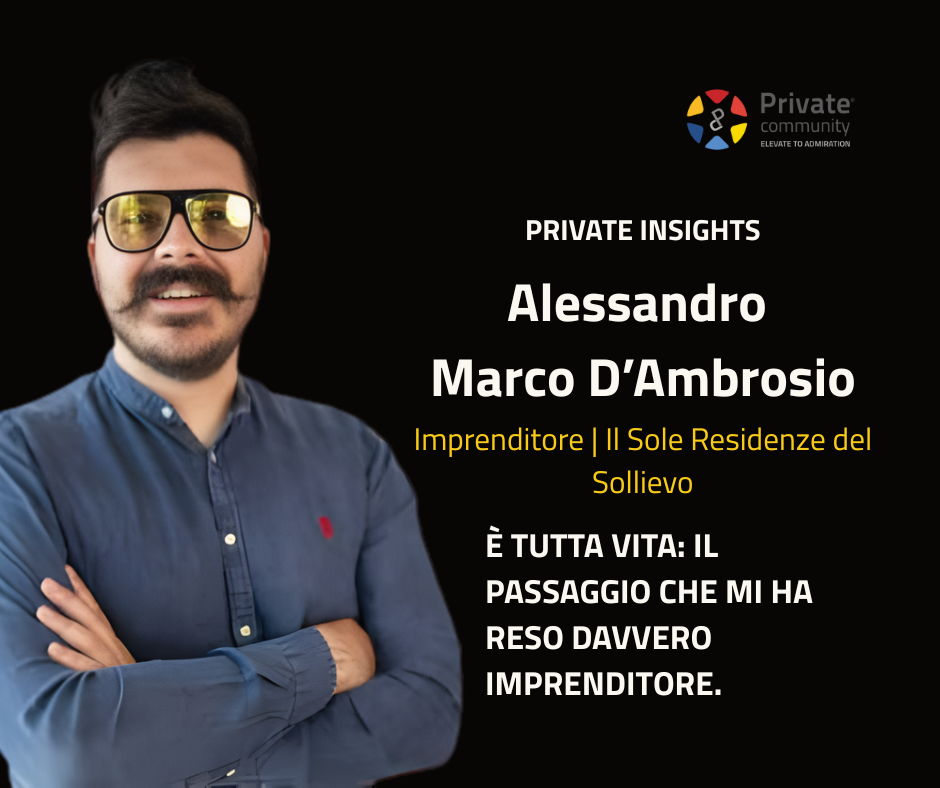
"IT'S ALL LIFE: MY TURNING POINT IN PRIVATE COMMUNITY."
The story of Alessandro Marco D'Ambrosio – Entrepreneur | Il Sole Residenze del Sollievo
At twenty-eight, I found myself in a very delicate moment. A moment when there's a lot at stake and you can't pretend nothing is happening. We are going through an important generational transition, I am about to establish a new company, a new branch of our group, and all this brings a huge burden.
I work in a group that deals with healthcare facilities for the elderly. We have several entities: an LLC, a foundation, a social cooperative, a volunteer association. We started years ago with a small facility, eight or nine beds, and today we've reached fifty-four, brick by brick, step by step. It's a job my mother built from nothing. She is English, came to Italy without even speaking Italian, and created everything with heart and soul.
I started early. At eighteen, I was already in the company doing the groundwork. Shifts, kitchen, wherever needed. And as I grew, I found myself in a complex reality, especially today, because our sector is in enormous difficulty. You can't find staff, you can't find roles, you can't find resources. It's tough.
And it is precisely in this context that Private Community was a turning point for me.
What struck me the most, and also positively shook me a bit, was the different way of asking for help. I came from other entrepreneurial organizations, where yes, you compare notes, but it's another thing. In Private, I understood what it really means to bring a problem to the table and get help without fear of judgment.
Everything started from understanding my mistakes and putting them on the table without filters. I started getting help with requests and with the Lab we do every week. It's there that you realize you're not alone, that you can bring a concrete problem and immediately receive real experiences from those who have already been through it.
From there, I practically built myself a mental framework. Not theory, but practical things that stick with you and that you apply the next day.
And I saw this not only in myself but also in others.
There's a guy in the community who has a dessert company, a pastry shop in Sanremo, an important reality, a flagship of the city. He had a very clear goal: to export his product worldwide. He always brought it to the table, talked about it continuously.
Then one week he didn't show up at the lab, and we wondered why. The reason was simple: that day, the company was taking measurements because he had just opened the production site. And in the meantime, he had already closed contracts worldwide.
Inside me, I thought: wow, it's beautiful. Because he built his success, of course, but bringing it to the community, in my opinion, accelerated everything. The contribution was finding himself in front of seven entrepreneurs who told him one thing: go. We are here. We will be here. We can't wait to share your success with you.
That push, that spark, sometimes is exactly what you need to really start what you already know how to do.
One of the most beautiful things for me was experiencing it together with my brother. We had drifted apart a bit in work. Each had their own mentality, there was no longer that calm, composed dialogue, it was always high tones. Instead, this journey brought us together.
I remember that at the first meetings, he would sit at the end of the table, detached from everyone, and I was on the other side of the room. Now, instead, he has almost become the nucleus of the group. And this thing for me is enormous.
I myself have changed.
Before, in the company, I had a role that was the boss's son, not the entrepreneur. And this weighs on you because then you feel not taken seriously. I took on everything. I absorbed other people's problems, lost energy solving things that weren't mine, and meanwhile, too many confidences, too many jokes were created. When I gave directions, they were not respected.
At a certain point, I realized I had to build boundaries. I started raising walls to safeguard myself and especially the company. Then, after months, I began to open windows. I found a balance. I understood what it means to be respected, to have a role, to truly be an entrepreneur.
And this had concrete effects on the staff as well.
I had a huge problem: feeling unattractive. In our sector, it's extremely difficult to find people. Until six months ago, if I received ten resumes, I would take the first one who said yes, and after a week, I was back to square one.
Today it's different. In just one afternoon, I received ten resumes and interviewed each one. Following the advice of the Community entrepreneurs, I learned to be direct, fast, present. To choose. Not to take the first thing that comes along.
And then there was another gigantic switch: organization.
I have always been disorganized, one without an agenda. One of "I'll do it later." Then I'll tell them, then I'll set the alarm, then I'll think about it. In Private, I built myself a mental framework: precision first. I started even just using Google on my phone to note appointments. After six months, I wake up and automatically look at the day. I had never done it in twenty-eight years.
But the most incredible thing, the one I didn't expect, was Combine®.
Until the first meeting, I was allergic to artificial intelligence. I really mean it. I thought that if I used it, I would no longer be able to think with my own head, to build my own project.
Then I made the first approach with Combine® and it pulled out things that made me say: wow.
I went home and started using it everywhere. During Christmas, I was in the office working on a system that designs the staff shifts automatically. I input three pieces of information, and it does it in forty seconds. Something that used to take me an entire day.
For me, that is time recovered. It's efficiency. It's clarity.
And the difference is that Combine® knows me. It's not a generic tool. It's about me. It knows who I am, how I work, what I'm building. It's like having constant support.
In these months, many things have changed for me: role, management of collaborators, habits, efficiency. And above all, I learned one huge thing: not to feel guilty if I take time for myself.
I saw my mother reach a point where she exploded. She spent two years in the hospital, three months in oncology. And then I understood: we don't have an expiration date like tomato sauce. I can't wait to live when it's too late.
Today, if I go for a walk on Saturday morning, I don't have to hide it. I don't have to feel guilty. Because life is one.
Like the name of the Private Community where I grew up in these six months: It's all life.
I even got that phrase tattooed on my wrist because it has become a way of being in the world for me. A continuous reminder. Life is short, it's fragile, it's unpredictable. I work with the elderly and see people reaching 65 with Alzheimer's who no longer recognize their children.
And then you realize that it makes no sense to live crushed by judgment, anxiety, and weight.
"It's all life" means this: we get up, we move forward, we grow. Together.